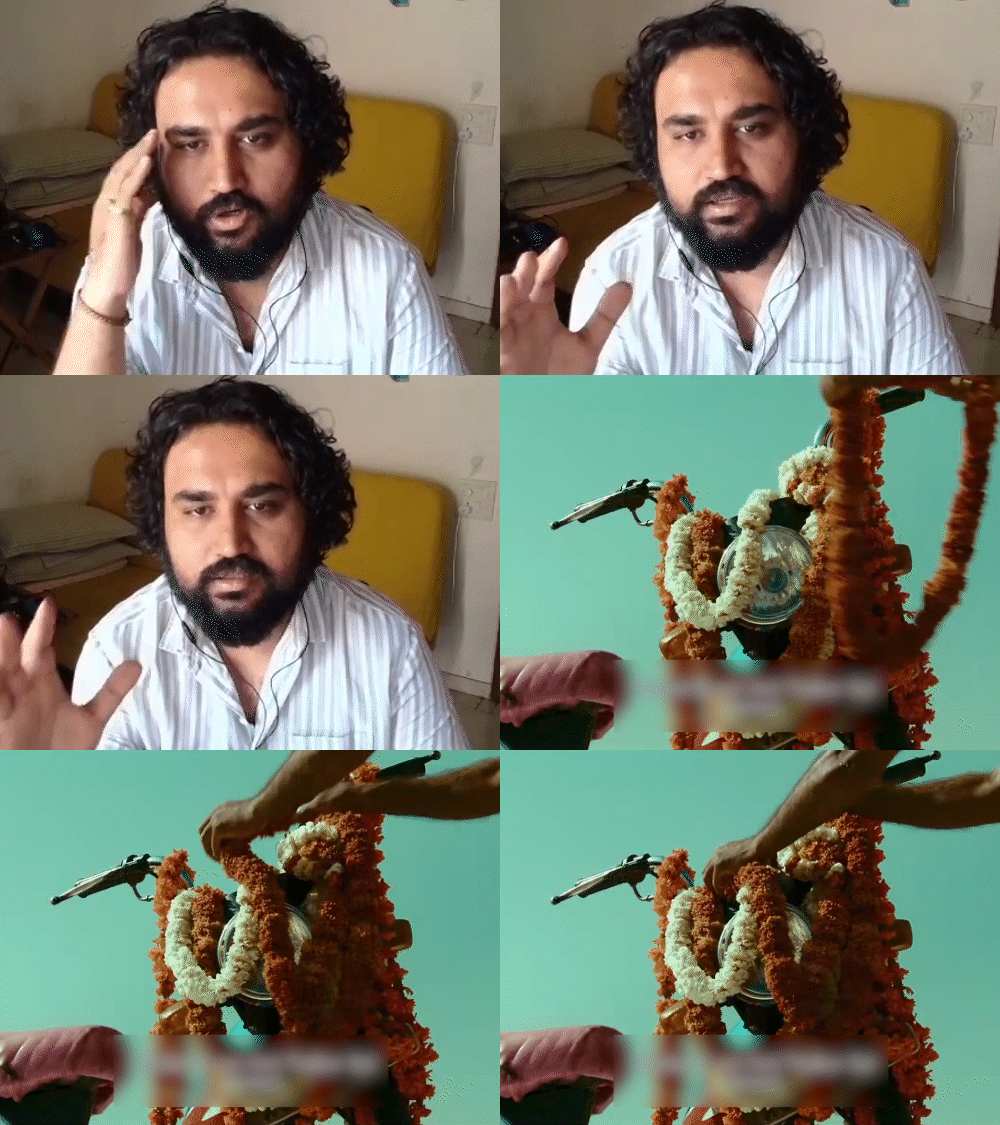
The trailer of Hindi film ‘Dug Dug’ is in discussion in Rajasthan. The story of bike (Luna), faith and miracles shown in the trailer seems to be directly matching with Om Banna Dham (Bullet Baba). People have many questions regarding this film based on the great symbol of folk faith of Rajasthan. Some are calling it a satire on superstition while others are considering it a humorous story. The film’s writer-director Ritwik Pareek gave candid answers to these questions in a special conversation with Dainik Bhaskar… Question: What is the reaction received from the audience of Rajasthan after the release of the trailer? Answer: We have received a good response from the trailer. However, there are some questions in the minds of people that are you showing the right thing? Now when you watch the film, you will automatically understand that everything is correct. In this we have not shown anything which is not correct. Question: What do you want to say as a writer and director from the film Dug Dug? Answer: Seeing the trailer, people feel that it is based on superstition or questioning religion. But this film is completely based on the fact that your thoughts shape your reality. It’s just like when you believe in something too much, it becomes manifest. In such a situation, the medium of this belief and manifestation can be anything – it can be a bike, it can be a statue and it can also be without any medium. Your thinking creates your universe, this is what we want to explain in this film. Question: While writing the script of this film, how much did you follow the incident of Om Banna Dham and how much did you create fiction? Answer: This is a mix. We have not placed it directly on them. The government had also asked us to tell that you have not mentioned the name, cast or anything like that. That’s why we changed the bike and everything else too. Although this is as similar as we could make. The rest are also some fiction, like theatrical adaptations. We have also ensured that no one feels bad. Nothing like this has been kept in this film, so even the censor was surprised to see where to make cuts in it. When we used colors in the film, we also took full care that they should be such that they look different. Because here red color became that of Durga Mata, some people consider black color for Lord Shiva and green color became that of Islam. In such a situation, the challenge before us was what color to use for them. So later this idea came that we would use the color of their car. The color of the seat is pink and the body is blue, so after the departure of the main character Thakur Saheb, people adopted these colors and that color became their identity. Question: When and how did you first know the true story of Om Banna (Bullet Baba)? Answer: My grandmother told me about it. I myself am from Jaipur, so my entire childhood was spent here and around Malviya Nagar. Grandmother used to take me to Khatu Shyam ji, Salasar and many temples, so I saw all this. Now I don’t remember when I went there for the first time. If you are in Jaipur then how does Govinddev ji know? This is just the case. Maybe I was in ninth class when we went to Jodhpur. Then I thought it was amazing brother, what is this! Later a film was made with this inspiration. Question: In the film, the ‘miracle’ of the bike (Luna) is shown after the death of the main character? Did you speak to witnesses or locals of the actual Om Banna incident? Answer: Yes, we have heard his story. I used to call my relatives in Jodhpur and Pali directly and they would tell me. Apart from this, there was a lot of material on news also. There is a scene in the film that when the reporter comes, he is also seen on the bullet till the end. We got this idea from a news. The research of the story is such that everything has been seen, but the main research was in art and designing. For this we took the help of paintings. We have tried to explain many things to people through paintings also. This was done by a local hand painter and a lot of hard work went into it. Question: Why was it chosen as a comedy-satire in the film? Answer: I wanted to convey both the points of view through this film. If people see it they will think what is this? That’s why when we showed it globally, we put a disclaimer during the interval in the middle of the film that this is a film made on a real incident. If we had put this in the beginning, they would have thought that it was written like this. Now I can’t tell you much, but at the end of the film you will agree that there is a satire, but at the same time you will also understand that there are some upper forces, which cannot be described, but they are there. It is the job of a human being to ask questions about such things. Question: Do you think that after the release of the film, some people may consider it to hurt religious sentiments? How do you handle such controversy? Answer: Now when someone watches the film, he will know that there is some power there. What can I say to someone who has not seen it? If you watch the film, you will understand that I have done my job properly. Otherwise I don’t think much about it. My clear motto, which I have written on the wall of my room, is that if you are fearless, you do not think much and true thinking comes only from fearlessness. My only work is to think and write. This is absolutely honest. Whatever happens now remains to be seen. Not to anticipate (predict). If you show any truth today, this will definitely happen. If you think too much then you will not be able to write down the true events. Question: The main character has been made a 40 year old drunkard Thakur and the rest also have a lot of connection with alcohol, what is this? Answer: I have told all this in the film and it will become more clear after watching the film. It is also the effect of the same thought shaping reality that you are offering anything. In ancient times it was offered as a sacrifice. The belief that you have instilled in you works. I also believe this and perhaps it is the law of the universe. Question: Did you try to get permission from Om Banna family…did you have any talks with them? Answer: When the idea of the film came and I started making it, I was still a child. Meaning, he was 27 years old and had made this film with great enthusiasm. Went to the temple there and enquired, also talked to the Panditji. But that was the only thing that you can take inspiration from. Now you will ask only if you make the film directly. Question: If Om Banna’s family or local people come to watch the film, what would you like to say to them? Have you invited them to watch a movie? Answer: I have not thought of this yet. They will also understand after watching the film and only the producer can tell them anything about inviting them to watch the film. I am just busy completing the film. Let’s see the rest about it. Question: How many temples (including Bullet Baba) have you visited in Rajasthan? What was the most surprising thing in this? Answer: Went to many temples like Mehndipur Balaji, Karni Mata Temple etc. Mehndipur Balaji has always been something special for me. There it is always felt that oh my god, don’t go here, don’t go there, don’t eat this. But now the next film coming is not a horror satire, but a cosmic horror. The second one is exactly the story of Jaipur. However, we cannot tell much about these two right now. If we look around the world, many funny elements come to the fore, but now I would hardly put the topic of religion and faith in the film again. Whatever had to be said has been said through this film. Question: How much space has been given to the rural culture, dialect and folk traditions of Rajasthan in the film? Answer: This entire film is almost in Rajasthani language. Because everything has been shot in and around Jaipur, it has the local language of Jaipur only. Artists are also from here. An artist who gets transferred from Bharatpur speaks in his Bharatpuri style. The rest is also some Hindi. Question: There was a wait of 5 years after the premiere at TIFF (Toronto International Film Festival) 2021 and now the film is releasing on May 8, 2026, why was there so much gap? Answer: From day one it was clear that we have to release this in theaters only. This film has also been designed in a similar theatre-style. It first premiered at the Toronto International Film Festival in IMAX, one of the largest screens in the world. After this we gained confidence and later it took so much time to bring it to the theatre. Question: Being your first film, how did it feel to have names like Anurag Kashyap, Nikhil Advani, Vikramaditya Motwane and Vasan Bala as executive producers? Answer: Another name is Ranjan Singh, who was looking after everything on the back end as an executive producer. Apart from these, the film gets a lot of support from other people associated with the film. These are all very big names. It is obvious that he must have found something good in it. It is a very good thing for all of them to join and I am feeling very grateful. I had never imagined that so many people would connect with this film. Everyone says that the fruit of patience is sweet, so we have got a little sweeter fruit with all this. Now let’s see what happens next. Filmmaker hails from Jaipur Born and brought up in Jaipur, Ritwik Pareek is a filmmaker, writer and illustrator, who currently lives in Mumbai. He started his career as an art director in an advertising agency. There he worked on advertising campaigns that won several international awards. After a year, he left this agency and made a career in film making. ‘Dug Dug’ is a satire and comedy film. This film has been written by Ritwik Pareek himself. Filmmakers like Anurag Kashyap, Nikhil Advani, Vikramaditya Motwane and Vasan Bala are supporting this film as executive producers. What is the story of Om Banna? Om Banna’s full name was Om Singh Rathore. He was the son of Thakur Jog Singh Rathore of Chotila village in Pali district of Rajasthan. He died in a road accident in 1988. After the accident, the police kept the bike in Rohat police station. It is claimed that the next day the bike disappeared from the police station and reached the accident site. The police then took the bike, emptied the oil, tied it with a chain and increased security. Yet the bike would repeatedly run away from the police station and return to the same place. Due to the claim of this miracle, he later came to be known as Bullet Baba. Gradually, Om Banna Dham was built there, where the bike is worshiped by offering flowers and garlands.
Source link
Film on ‘Bullet Baba’, story of superstition or faith?: Director said – It showed how thinking becomes reality; Told-Why didn’t you take permission from Om Banna’s family? – Rajasthan News

Byayoobkk2022@gmail.com
Apr 30, 2026