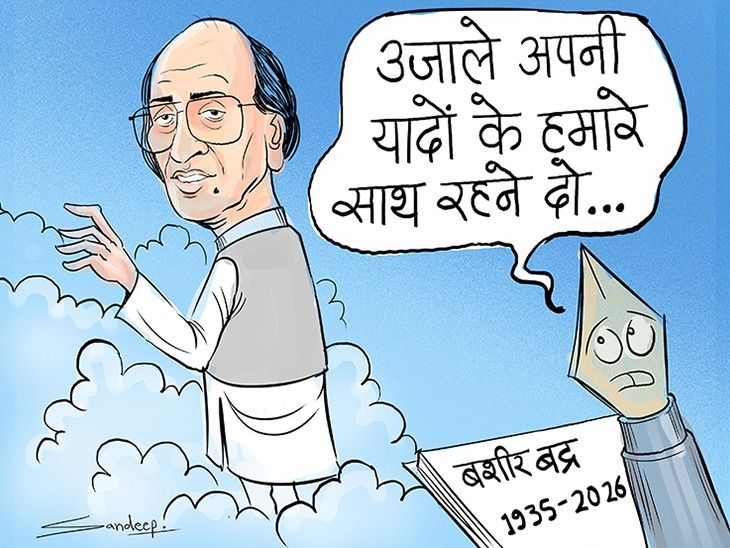
Shahenshah of Urdu Ghazal Dr. Bashir Badr (91) is no more. He bid farewell to this world in Bhopal at 12:15 pm on Thursday. Bashir Badr, the soul of Urdu literature, suffered from dementia for almost 14 years, due to which his memory became weak, but his couplets still beat in the hearts. He will be laid to rest today at 7:30 pm in the cemetery near Bhopal Talkies. When his wife, Dr. Rahat Badr, would hum his couplets, a slight glow of joy would appear on Bashir Sahab’s face. Sometimes he himself would start completing the Misra. There was a time when Mushairas were considered incomplete without him. His presence was a guarantee of the success of the gathering. Whenever he remembered Mushaira, he used to say Irshad, Irshad. Pain, love and truth of life in poetry: The essence of love, the bitterness of life, the restlessness of urban hustle and bustle and the fragrance of Indian soil are found in the poetry of Dr. Badr. His couplets have been resonating from the streets to the Parliament. His ghazals touched the hearts of people across the country and the world and stuck on their tongues. “There must have been some compulsions, no one is unfaithful like this.” This is not just a couplet, but a feeling which became the voice of every betrayed heart. Look at the nature of his poetry – “The flowers of sadness blossom from my laughter, I am with everyone, but I feel separated.” This fun makes them different from everyone else. He gave Urdu Ghazal the language of the common man, gave it a new tone and gave it new feelings. The couplet that made Bashir Badr accepted. Born on 15 February 1935 in Kanpur, Uttar Pradesh, Bashir Badr started poetry at an early age. But I got acceptance from this couplet – “Let the light of your memories stay with us, who knows in which street the evening of life may happen.” In the 1960s, famous actress Meena Kumari wrote this couplet in her own hands and gave it to a magazine. Just what then! Bashir Badr’s journey to fame gained momentum. Her couplets continued to resonate in political circles and mushairas. Her poetry was not limited to mere beauty and love. He also wrote openly on social issues. He described the pain of the partition of the country in this way – “Enmity should be done fiercely but there should be scope for whenever we become friends, we should not feel ashamed.” He had read this couplet on the occasion of Shimla Agreement. Then when he got an invitation for Mushaira from Pakistan, the same couplet was recited there too and there was silence in the gathering. Meerut riots changed the direction of his life. His house was burnt in the Meerut riots of 1987. This accident was very painful for him. He summed up this pain in his words – “People break down to build a house, but you do not feel pity in burning settlements.” After this accident, he made Bhopal his home and stayed here. New style of poetry and use of new words. The most special aspect of Dr. Badr’s poetry is that he put Ghazal into simple words. His poetry is neither trapped in the heavy words of Arabic-Persian nor is it a slave to traditions. He gave place to new words in Ghazal, made new experiences and gave a new dimension to Ghazal. “Since the day I started, I have my sights set on my destination. My eyes have never seen a milestone.” Dr. Badr, who was topper in education, also had a wonderful intellectual journey. He is a gold medalist of Aligarh Muslim University. Interestingly, when he went there to study, his own Ashars were included in the MA course. Before poetry, his father had passed away when he was about 15-16 years old. He was forced to join the police service. But the love for poetry remained intact. During this time, he was offered a promotion, but he refused and said a memorable couplet – “Always keep a distance when meeting big people, where the river meets the sea, the river no longer exists.” Special couplet for daughters: He expressed the importance of daughters in this way – “She is a branch and not a flower, if there are no butterflies then a house is not a house where there are no girls.” Badr’s poetry gave a new color to Urdu literature. The fragrance of feelings, the warmth of love and the intensity of pain come together in his ghazals. Many people become proud after getting a position. They harbor illusions. He also warned such people and wrote – “The height of fame is also a momentary show; the branch on which you are sitting can also break.” Said about his wife – Rahat had a big role in the completion of the ghazals. Bashir’s wife Rahat Badr has been a good writer and teacher. She not only took care of the house but also acted as the biggest ‘support system’ in his literary journey. Bashir often said that his wife had a big role in the completion of many nuances of his poetry and ghazals. She has been his most honest critic. About their marriage, it is said that both of them complement each other’s personality. Bashir had participated in Mushairas continuously for 60 years. He used to rest during the day and go to mushairas till late night. Even after dementia, his routine was set, he used to stay awake at night and sleep during the day. During the last few years he used to recite his ghazals. There must have been some compulsions…Bashir’s 10 famous poems, 3 stories related to Bashir, number came in Mushaira at midnight, recited poetry for hours, Badr Saheb in photos……………………….. Also read this news, Kanpur-born famous Urdu poet Bashir Badr passed away. Famous Urdu poet Bashir Badr passed away on Thursday afternoon at the age of 91. The news of his demise caused a wave of mourning in the world of literature and Urdu literature. Bashir Badr was born on 15 February 1935 in Kanpur. His ancestral home was in Basheerganj in Colonelganj area of the city. His real name was Syed Mohammad Bashir. Read the full news…
Source link
Poet Bashir Badr dies at the age of 91: Had lost his memory, used to say Irshad-Irshad on remembering Mushaira – Bhopal News

Byayoobkk2022@gmail.com
May 28, 2026