
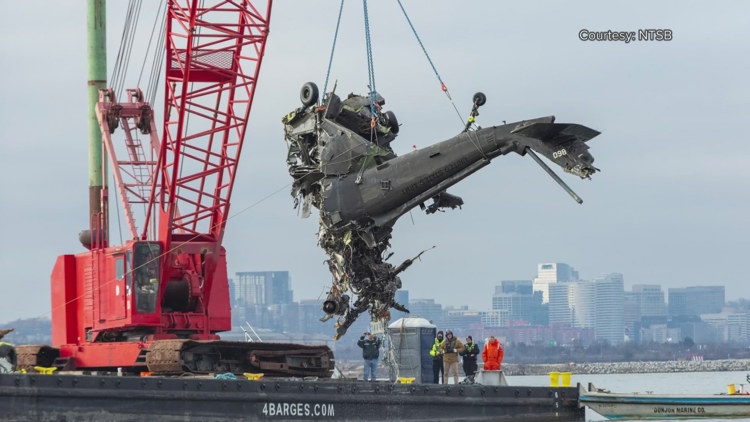
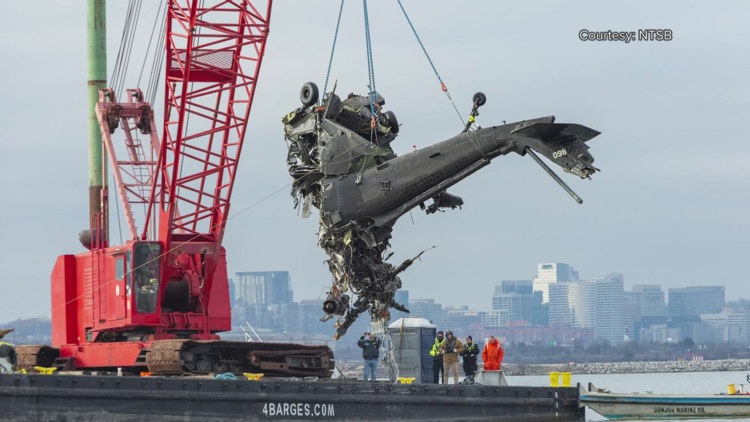
As the anniversary of the Potomac River midair collision nears, the NTSB gave reporters a look inside their ‘accident’ labs.
WASHINGTON — Next week marks a somber milestone for the DMV: the one-year anniversary of the midair collision between American Airlines Flight 5342 and a U.S. Army Black Hawk helicopter over the Potomac River.
As the region prepares for the National Transportation Safety Board’s final findings on that tragic night, WUSA was granted rare access inside the National Transportation Safety Board’s investigation labs. It is here, far from the riverbanks and the spotlight, where a team of “wreckage detectives” work to reconstruct how tragedy happens—and how to prevent it from ever happening again.
The Science of the Crash Site
When an accident occurs, NTSB investigators hit the ground like crime scene detectives. The real work begins at the site, but critical components make it back to Washington, D.C.
“Very quickly, we will ship stuff back here if we suspect there’s an issue and let the lab team take a look at it,” says Mike Budinski, NTSB Acting Director of Research and Engineering.
Inside the lab, high-powered microscopes and 3D scanners are used to examine every bolt and blade. Engineers look for “witness marks”—tiny scratches or stress fractures that reveal if a part failed in mid-air or broke upon impact. In one corner of the lab, an engineer pores over a broken rotor blade, searching for microscopic wood samples that might prove the aircraft struck a structure before hitting the ground.
Decoding the ‘Black (Orange) Box’
Perhaps the most famous piece of any investigation is the “black box”—which is actually a bright orange cylinder designed to survive extreme heat and pressure. NTSB officials said it can sustain up to 2,000 degrees of heat and more than 20,000 feet of pressure in water.
Inside the cylinder is a small, hand-sized “puck” containing memory chips. “Those chips are analogous to SD memory cards,” investigators explained. Even if the rest of the aircraft is destroyed by fire or impact, as long as that puck survives, the data does too.
In a specialized sound room, a team listens to the final minutes of cockpit recordings, pulling audio from the chips to hear exactly what the pilots were seeing and saying. For the Potomac crash, this work was vital in understanding the radio transmissions that may have prevented the helicopter crew from hearing critical instructions from Air Traffic Control.
A Mission Beyond the ‘Why’
While the immediate goal is to find out what happened, NTSB Chair Jennifer Homendy says the agency’s true mission is broader.
“[The goal is] to find out exactly what happened and to prevent a tragedy from happening again.”
The NTSB is scheduled to hold a public board meeting on Tuesday, January 27, to officially determine the probable cause of the Potomac collision.