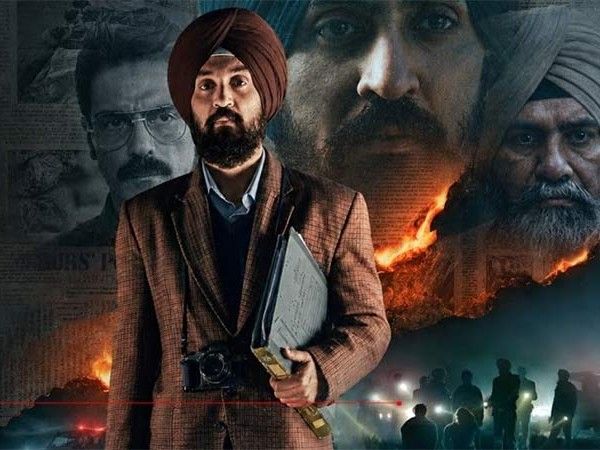
Punjabi actor and singer Diljit Dosanjh’s film Sutlej has now been completely banned. It has also been removed from the global category of OTT platform ZEE5. Now this film will not be seen even abroad. Along with this, the Central Committee formed to investigate the content of the film has also recommended that the film should remain banned. Because, the film is against the sovereignty and integrity of India. This information was given by news agency PTI on Saturday quoting government sources. According to sources, the committee stressed that banning the film under Section 69A of the IT Act was justified. It found that the film’s story is not balanced, as it hides the actions of the militants. Whereas, it highlights the excesses committed by the security forces in Punjab during the insurgency. The film depicts the life of human rights activist Jaswant Singh Khalda, who investigated the cremation of thousands of unidentified bodies in Punjab between 1984 and 1994. In 1995, he was kidnapped and murdered by the Punjab Police. Citing security concerns, the Ministry of Information and Broadcasting removed the film from ZEE5 in India just two days after its release on July 3. After this, the ministry constituted an inter-departmental committee (IDC) under the Information Technology Rules 2021 for a detailed investigation of the film. The same committee has recommended banning it. This issue has taken political color in Punjab. The Shiromani Gurdwara Parbandhak Committee (SGPC) has demanded lifting of the ban and the Shiromani Akali Dal (SAD) has announced screening of the film across the state. What is it in this film that is being banned, will this film be released again? Know the answers to all the questions in questions and answers. What is there in this film, due to which it was banned? The film is based on the life and struggle of famous human rights activist Jaswant Singh Khalda. Diljit Dosanjh has played the role of Khalda in the film. It depicts the story of Khalda’s discovery and documentation of the bodies of Sikhs who were burnt as unclaimed by the police during the period of militancy in Punjab in the 1980s and 1990s. The film shows that Khalda obtained municipal corporation records from the cremation grounds of Amritsar and Tarn Taran, which proved that thousands of youth were killed in illegal detention by the police. During this time, Khalda stood before the state system by showing courage. After bringing the truth before the world, Khalda was also killed by the Punjab Police in September 1995. What aspects of the film were controversial? There was politics over the ban, what did the parties say? Shiromani Akali Dal (SAD) SAD President Sukhbir Singh Badal called this ban an attack on freedom of expression. “This is not mere censorship, but an attack on our collective memory, truth and freedom of expression. Punjab deserves to confront its past honestly, not through repression,” he wrote. Akali Dal announced that to challenge this ban of the government, it will do special screening of this film in every village and Gurudwara of Punjab, so that the youth can know their identity and history. Senior Congress leader and MLA Sukhpal Singh Khaira condemned this step of the central government. He said it is unjust to stop the film which shows the truth about Khalda’s kidnapping and police brutality. Other party leaders alleged that when films with sensitive narratives like The Kashmir Files and The Kerala Story can be allowed without any hindrance, banning Sutlej based on facts and court decisions shows the double standards of the Central government. Aam Aadmi Party (AAP) Punjab’s ruling AAP also criticized the decision to remove the film from ZEE5. Party spokespersons demanded that the film should be immediately restored as it is extremely important for the new generation to understand this painful and historical truth of the state. Shiromani Gurdwara Parbandhak Committee (SGPC), the supreme body of Sikh religious affairs, has fully supported the film. He said that the sacrifice of Jaswant Singh Khalda is supreme for the Sikh community and efforts to suppress his voice through the film will never succeed. Bharatiya Janata Party (BJP) Union Minister of State Ravneet Singh Bittu raised questions on the timing of the film and its narrative. BJP argues that during elections or sensitive times, such films can again create unrest in Punjab. What did the Center say against the film? What did the central government do after the release of the film? 1. The film was immediately removed using Section 69A of the IT Act. Within just 48 hours of the film’s release, the Ministry of Information and Broadcasting of the Central Government used the emergency powers obtained under Section 69A of the IT Act and the IT Rules, 2021. The government issued written instructions to ZEE5 to immediately remove the film from its platform in India, citing security concerns and disturbance of public order. 2. Formation of high-level special committee: The Center did not stop at merely removing the film. The Central Government formed a high-level inter-departmental committee under Rule 14 of the IT Rules 2021 to examine its content in depth. This special committee was given the responsibility of reviewing the film’s visuals, narrative and its possible socio-political implications and submitting a final recommendation to the government. 3. Instructions to strictly follow the rules of CBFC: The Central Government made it clear that no film producer can bypass the certification process of the Censor Board (CBFC) and release such sensitive films directly on OTT. The government took the stance that if the film was to be streamed or released again in India, the makers would have to follow the prescribed legal norms and the cuts suggested by the board. What is the current status of the film? Following the government order, Satluj has been completely removed from both the Indian and international catalogs of ZEE5, making it officially defunct. Despite this, the pirated version of the film is going viral as well as being circulated through community screenings in rural areas. What will happen next in this dispute?
Source link
Diljit’s film Sutlej completely banned: Also removed from ZEE5 Global category, Central Committee submitted report; Now what next? Know everything in questions and answers – Jalandhar News

Byayoobkk2022@gmail.com
Jul 12, 2026