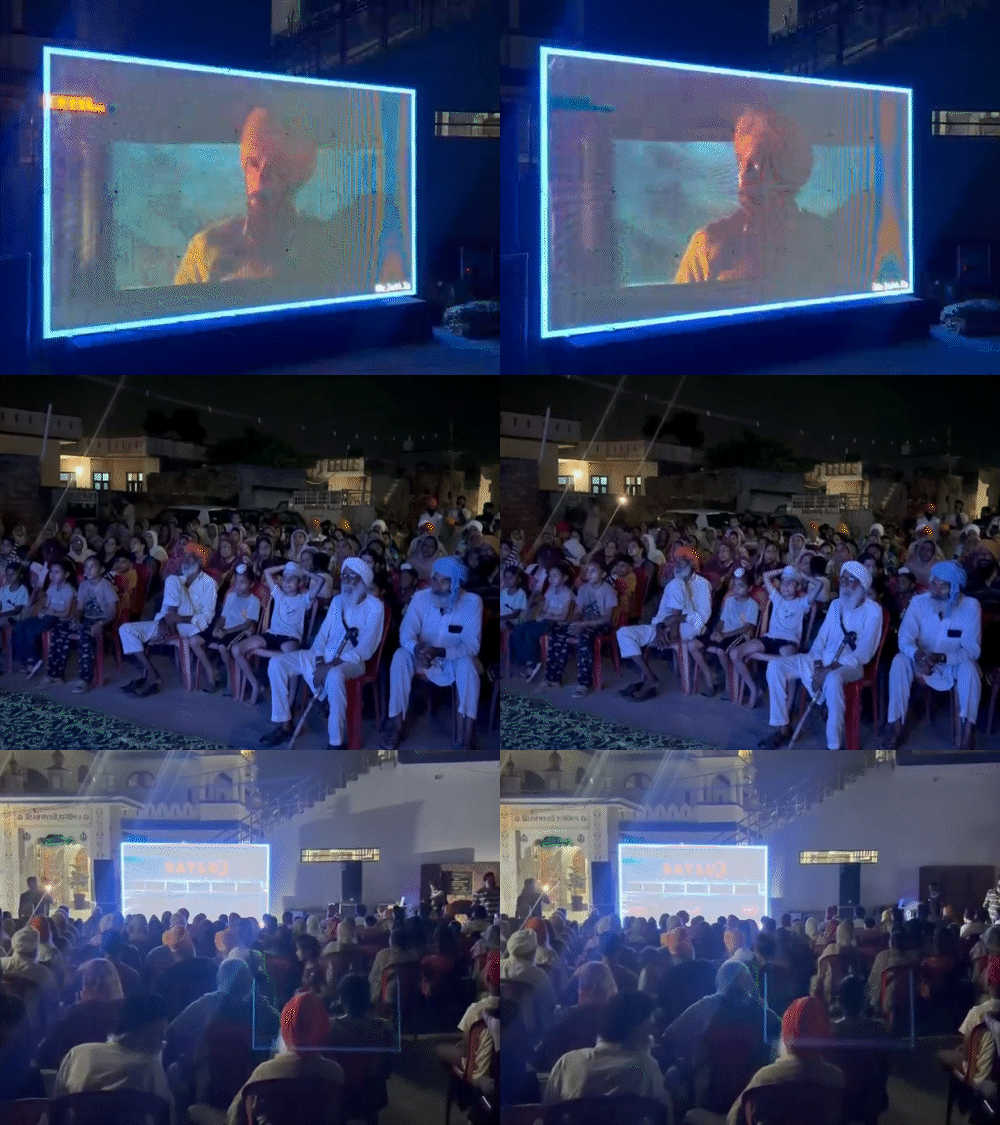
Diljit Dosanjh starrer film ‘Sutlej’, which was removed from OTT platform, will now be shown for free in Gurudwaras in Punjab. This film is based on the life of human rights activist Jaswant Khalda, who claimed to have killed 25 thousand youth in a fake encounter during the era of terrorism in Punjab in the 90s. Screening of films has started in Gurdwaras from Gurdaspur. Here in village Manchopra, the film was shown to the villagers by making an announcement from Gurudwara Sahib. The film was also shown in the Gurudwara of Moga. Now its screening has been announced on Wednesday and Thursday in two major Gurudwaras of Pathankot, Gurdwara Singh Sabha, Model Town and Gurdwara Singh Sabha Central (Ranipur). Meanwhile, Union Minister of State Ravneet Singh Bittu targeted Diljit. He said that this film is not a service to any Sikh sect or Punjab but a well-thought-out script and publicity stunt to earn crores of rupees. The person who touches the feet of 1984 culprits for money is an impostor who is selling the pain of Punjab today. He said that in foreign countries you (Diljit) ask to expel those people who bring the flag of Khalistan. What are you, friend? You are an impersonator from every side. Wherever you see money coming from, you pick up your bag and go there. The film will be taken to every village Punjab Youth President of Bharatiya Kisan Union Inderpal Singh Bains said that the film will be taken to other districts and villages of Punjab, so that more and more people can watch it. At the same time, Delhi Sikh Gurdwara Management Committee (DSGMC) has also announced screening of the film in schools and colleges. Gurudwara managers claim – an attempt was made to suppress history. Gurdwara manager of Pathankot Manpreet Singh says that the film is based on the life and struggle of human rights activist Bhai Jaswant Singh Khalda. They allege that the film was deliberately removed from the OTT platform to prevent an important chapter of Punjab’s history from reaching the people. He says that if the film will not be shown on the digital platform, then it will be taken to the people through Gurugharas, so that the new generation can become familiar with Khalda’s struggle, fight for human rights and his sacrifice. Senior lawyer said – Screening in Gurudwaras is not illegal. Regarding its public screening despite its removal from OTT, Pathankot’s senior advocate Vishal Kohli said that screening the film for Sangat in Gurudwaras is not a violation of any law. According to him, the content of the film has already reached people on different online mediums. In such a situation, demonstrating it for the purpose of social awareness cannot be considered illegal. DSGMC’s announcement – The film will be shown in schools and colleges along with Gurudwaras. Delhi Sikh Gurdwara Management Committee (DSGMC) has also come out openly in support of the film. Committee Chairman Harmeet Singh Kalka said that stopping this film made on the life of Jaswant Singh Khalda is an attempt to suppress history. He announced that public screening of the film would be held in Gurudwaras of Delhi. Besides, seminars will be organized in schools and colleges on the life, struggle and human rights of Jaswant Singh Khalda. An appeal has also been made to all Gurudwara committees to take the film to as many people as possible. What was shown in Diljit’s film, on which there was objection? In this film of Diljit, the scene of murder of former CM Beant Singh in a bomb blast is also shown. This scene is shown as a turning point of police brutality for the film’s story. The film also shows how due to police brutality and increasing atrocities on innocent people, a common man breaks down from within and is forced to take terrorism or such steps. In this, the then DGP KPL Gill has been shown as IPS Bitta. It is shown in the film that the then CM Beant Singh is murdered on 31 August 1995 and exactly a week after this incident, i.e. on 6 September 1995, Jaswant Singh Khalda is also kidnapped. When the political environment changed after the death of the Chief Minister, the police feared that Khalda might expose his dark secret of 25 thousand illegal cremations to the world, so they took the step of kidnapping Khalda. What is the Centre’s concern regarding the removal of the film, what further decision was taken? The Center has not yet said anything formally regarding the removal of the film. However, according to media through government sources, there is a possibility of some parts of the film being misused by anti-India forces. According to sources, there is concern that some scenes and content of the film may be used to create an atmosphere in favor of the pro-Khalistan movement. This can happen especially before the Punjab Assembly elections. The government believes that “in such cases, issues related to national security are paramount. This is not a matter of politics. However, the Center has formed a review committee on this after the appeal of BJP’s Punjab President Kewal Singh Dhillon. The committee will study the content, facts and topics presented in the film. Know about Jaswant Singh Khalda, on whose life this film was made. When he worked in a bank, started searching for unclaimed dead bodies. Punjab’s 1990s The demand for Khalistan was gaining momentum in ‘Blue Star’, in response to which PM Indira Gandhi was assassinated on 31 October 1984. After this, Beant Singh became the CM of Punjab. DGP Kanwar Singh Gill had a free hand in arresting unarmed people overnight. Born in Khalda village in 1952, he worked in a bank in Amritsar. Due to lack of death certificates, Jaswant started searching for connections between the dead bodies in the cremation grounds of Amritsar and Tarn Taran. In this case, Khalda said that under Chapter 25 of the Punjab Police Rules, 1934, a dead body can be cremated only when its identity is confirmed. Two days later, DGP KPS Gill replied in the press conference, ‘Thousands of Sikh youth have gone abroad on the basis of fake documents. Imposing. After this Khalda challenged Gill to an open debate. Local newspapers of Punjab were publishing news based on his claims. When pressure increased on the administration, they started interrogating Khalda instead. Meanwhile, on August 31, CM Beant Singh was assassinated in a bomb blast by Khalistani terrorist organization ‘Babbar Khalsa International’ (BKI). After this came the day of 6 September 1995. Jaswant Singh was washing the car outside his house in Kabir Park, Amritsar. Just then a white car arrived. The armed people present in it kidnapped him. Police said that there is no information on how Jaswant disappeared. After investigating Khalda’s case, CBI wrote in its report, ‘Jaswant Singh raised his voice in the matter of unclaimed dead bodies. The local police did not like this and kidnapped him from his home. After keeping him in illegal custody, he was murdered and his body was thrown in a canal in Harike area. How Khalda’s murder came to light: On September 6 itself, Jaswant’s wife Paramjeet Kaur lodged a complaint that her husband had been kidnapped by some people in police uniform. A case of kidnapping was registered. A reward of Rs 1 lakh was also kept for giving clues about Jaswant. However, when the police did not proceed with the investigation, Paramjeet approached the court and in November 1995 the court ordered the CBI to investigate. According to the CBI report, Jaswant’s neighbor Kirpal Singh Randhawa told that in the vehicle from which Jaswant was kidnapped, there were 5 police officers – DSP Jaspal Singh, Surinder Pal Singh, SHO Jasbir Singh, Prithipal Singh and SHO Satnam Singh of Jhabal police station of Amritsar. It was they who kidnapped Jaswant. Two days ago, i.e. on September 4, an accused Kulwant Singh was brought to Jhabal police station in an illegal drugs case. He also told CBI that DSP Jaspal Singh and SHO Satnam Singh had brought Khalda to the police station. Special police officer Kuldeep Singh became the most important witness in this case. He was posted with Satnam Singh in Jhabal police station. Kuldeep gave complete details till the murder of Khalda… Kuldeep had got the job of feeding Khalda in the police station. Khalda’s health had deteriorated badly. One evening SSP Ajit Singh Sandhu, DSP Jaspal Singh, their bodyguard Arvinder Singh came in an unnumbered car. SHO Satnam Singh, SHO Jasbir Singh and Prithipal Singh came in the second car. Everyone went to Khalda’s room. Sandhu asked Khalda to stop all his activities and also beat him. After 3 days, Satnam Singh took Khalda to Sandhu’s house in Tarn Taran. After closed-door talks here, Khalda was brought back to the police station. After a few days, DSP Jaspal Singh, Arvinder Singh, Surinder Pal Singh, Jasbir and Prithipal again came to the police station and started beating Khalda. Kuldeep Singh was asked to bring hot water. When he came out of the room, he heard two gunshots. Khalda had died. Blood was flowing from the body. His body was kept in the trunk of the van. Then 7 policemen including Kuldeep Singh went to nearby village Harike in three cars. Where Khalda’s body was thrown into the canal. Kuldeep Singh’s testimony proved to be very important for this case. In November 2005, a Patiala court sentenced four accused – Satnam Singh, Surinder Pal, Jasbir and Prithipal – to seven years in prison for kidnapping. While DSP Jaspal Singh and Amarjeet Singh got life imprisonment for murder. Whereas Sandhu committed suicide on 23 May 1997 even before the decision in the case was taken. Jaswant’s wife Paramjeet Kaur appealed in the High Court to increase the sentence of 4 accused. In 2007, the Punjab High Court acquitted Amarjeet Singh, while increasing the sentence of the four accused who were sentenced to 7 years to life imprisonment. The accused police officers went to the Supreme Court against the High Court’s decision, but the Supreme Court rejected their appeal on 11 April 2011 and upheld the High Court’s decision. CBI told the Supreme Court in its interim report, ‘2097 dead bodies were cremated as unclaimed. In Tarn Taran alone, 984 dead bodies were burnt as ‘unclaimed’. The police had killed a large number of innocent people. ************** Also read these news… Diljit’s ‘Sutlej’ released 2 days ago was removed from OTT, Dosanjh appealed against piracy. Diljit Dosanjh’s film based on the life of Punjab human rights activist Jaswant Singh Khalda was suddenly removed from the OTT platform. Khalda had claimed to have killed 25 thousand youth in a fake encounter in Punjab during the era of terrorism. This film was released 2 days ago with a changed name after a pause of 3 years. Earlier its name was ‘Punjab 95’, which was released on OTT platform with the name ‘Sutlej’ (Read full news)
Source link
Bittu said on Satluj – Diljit Dosanjh impersonator: Earned money by selling pain; Film removed from OTT, will be shown free in Gurudwaras – Pathankot News

Byayoobkk2022@gmail.com
Jul 8, 2026